
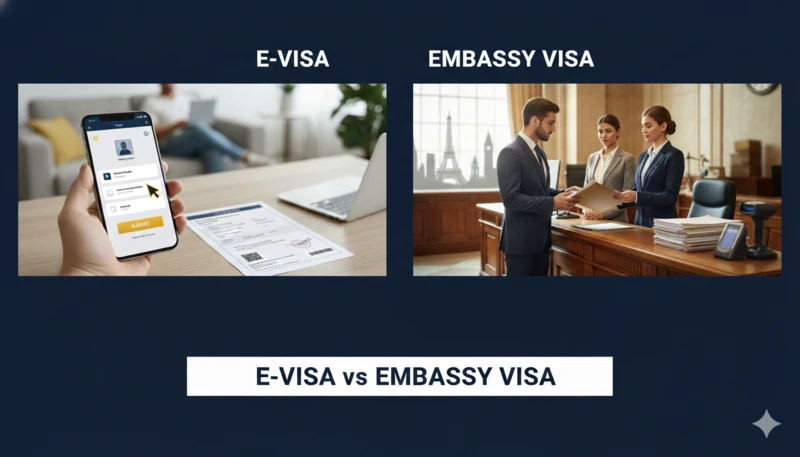
Meta Description: E-Visa vs Embassy Visa: Complete comparison guide. Understand differences, advantages, and which to choose. Expert guidance from Global Sky Visa.
Introduction
Planning your next trip but feeling confused about visa options? You’re not alone. In today’s digital age, travelers face a choice that didn’t exist a decade ago: e-visa vs embassy visa. Should you apply online from the comfort of your home, or head to the embassy with a folder full of documents?
The good news? Both options can get you where you want to go. The better news? Understanding the difference between e-visa and regular visa will save you time, money, and quite a bit of stress.
The visa application world has been revolutionized by e-visas. What once required taking time off work, standing in embassy queues, and waiting weeks for approval can now sometimes be done in minutes from your phone. But is e-visa always the better choice? Not necessarily.
In this comprehensive guide, we’ll break down everything you need to know about both visa types, compare them side-by-side, and help you decide which option works best for your travel plans. Whether you’re a seasoned traveler or planning your first international trip from Dubai, you’ll have all the answers by the end.
Let’s dive in and demystify the visa application process together.
What is E-Visa? The Digital Revolution
Direct Answer: An e-visa (electronic visa) is a digital visa that you apply for entirely online without ever visiting an embassy or consulate. The entire process—from application to approval—happens electronically.
Understanding E-Visa
Think of an e-visa as the modern, streamlined cousin of the traditional visa. Instead of filling out paper forms, printing documents, and scheduling embassy appointments, you complete everything on your computer or smartphone.
Here’s How E-Visa Works:
When you apply for an e-visa, you visit the official government website of your destination country, fill out an online form, upload digital copies of your documents (like passport scans and photos), pay the fee with a credit card, and submit. That’s it.
The immigration authorities review your application electronically. If approved (which usually happens within a few days), they send your e-visa directly to your email. You simply print it out and present it at the airport along with your passport. Some countries even accept the digital version on your phone—no printing necessary.
The E-Visa Evolution
E-visas aren’t brand new, but they’ve exploded in popularity over the past decade. Turkey pioneered the system in 2013, and it was such a success that dozens of countries quickly followed suit. The COVID-19 pandemic accelerated adoption even further as countries sought contactless solutions.
Today, over 60 countries offer e-visa options, and that number keeps growing. From popular destinations like India, Turkey, and Australia to emerging markets like Kenya, Sri Lanka, and Azerbaijan, e-visas are becoming the norm rather than the exception.
Why E-Visa is Growing Fast
The appeal is obvious: convenience meets efficiency. Travelers love not having to take time off work for embassy visits. Governments appreciate reduced administrative burden and faster processing. Tour operators and airlines benefit from simplified booking processes.
For UAE residents planning trips from Dubai, e-visas have been particularly transformative. Countries that once required complex visa processes now offer simple online applications, opening up new travel possibilities.
Countries Popular with Dubai Travelers Offering E-Visa:
- Turkey (instant approval often)
- India (typically 3-5 days)
- Sri Lanka (1-3 days)
- Kenya (quick processing)
- Australia (ETA – Electronic Travel Authority)
- New Zealand (NZeTA)
- Vietnam (3-5 days)
- Cambodia (3 days)
- Azerbaijan (3 days)
- Ethiopia (quick approval)
The e-visa revolution has genuinely changed how we travel, making the world more accessible one digital application at a time.
What is Embassy Visa? The Traditional Approach
Direct Answer: An embassy visa (also called traditional or regular visa) requires you to physically apply at the embassy or consulate of your destination country, submit documents in person, and often attend an interview.
Understanding the Traditional Process
Embassy visas represent the “old school” way of getting travel authorization—but don’t mistake traditional for outdated. For many countries and visa types, the embassy route remains not just necessary, but often the more thorough and reliable option.
The Embassy/Consulate Role:
Embassies and consulates act as the official representatives of foreign countries on UAE soil. When you apply for an embassy visa, you’re essentially walking into a piece of that country’s territory in Dubai or Abu Dhabi. Immigration officers there have the authority to review your case, conduct interviews, and make decisions about your visa application.
When Embassy Visa is Required
Despite the e-visa boom, embassy visas aren’t going anywhere. Here’s why:
For Major Destinations: Countries like the United States, United Kingdom, Canada, and the Schengen zone still require traditional embassy applications for most visa types. These nations want the thoroughness that comes with in-person processing—document verification, biometric collection, and sometimes face-to-face interviews.
For Complex Visa Types: While e-visas work great for short tourist trips, they can’t handle everything. Want to:
- Study abroad for a year?
- Work in another country?
- Migrate permanently?
- Bring family members for long stays?
- Apply for business establishment visas?
You’ll need an embassy visa for these complex situations.
The Application Procedure Overview
Here’s What Embassy Visa Applications Typically Involve:
First, you determine which embassy or visa application center handles your destination (in UAE, this might be the embassy in Abu Dhabi or a VFS center in Dubai). You check their specific requirements—every country has different rules.
Next, you gather physical documents: passport, photographs, bank statements, employment letters, travel itineraries, hotel bookings, and often much more. You fill out application forms (sometimes online, sometimes by hand), and book an appointment.
On appointment day, you visit the embassy or visa center, wait your turn, submit your documents, provide biometric data (fingerprints and photos), possibly attend an interview, and pay the visa fee. Then you wait—anywhere from a few days to several weeks—before collecting your passport with the visa stamp inside.
It’s more involved than e-visa, yes. But it’s been the standard process for decades, and millions of travelers successfully navigate it every year.
Why Embassy Visa Still Matters
Don’t think of embassy visas as outdated. Think of them as comprehensive. When you need:
- Personal guidance for a complex situation
- Face-to-face clarification of your circumstances
- Official documentation for long-term plans
- Visas to countries that don’t offer e-options
The embassy route is your answer. And honestly, for first-time travelers to certain destinations, the structure and support of the embassy process can be reassuring rather than frustrating.
E-Visa vs Embassy Visa: The Complete Comparison
Now let’s put them head-to-head. Here’s your comprehensive e-visa or embassy visa comparison table:
| Aspect | E-Visa | Embassy Visa |
|---|---|---|
| Application Method | 100% online from anywhere | In-person at embassy/consulate/VFS center |
| Where You Apply | Official government website | Physical embassy or visa application center |
| Processing Time | 1-7 days typically (some instant) | 5-15 days average (can be longer) |
| Cost | Usually AED 100-300 | Often AED 300-800+ (varies widely) |
| Convenience | Apply from home, office, anywhere | Must visit specific location during business hours |
| Travel Required | None—completely remote | Yes, travel to embassy location needed |
| Documents Needed | Digital scans/uploads | Physical original documents |
| Interview | Never required | Sometimes required (especially USA, UK) |
| Biometric Data | Not needed for most e-visas | Fingerprints and photo usually required |
| Appointment | No appointment necessary | Usually requires scheduled appointment |
| Availability | Limited countries (60+) | Available for virtually all countries |
| Approval Rate | Generally high (90%+ for complete applications) | Varies by country and visa type |
| Visa Types Available | Mainly tourist and business (short stays) | All types (tourist, work, study, family, etc.) |
| Duration Offered | Usually 30-90 days | From days to years depending on type |
| Complexity | Simple, user-friendly forms | More detailed applications, complex requirements |
| Support Available | Online chat, email help | In-person assistance at counter |
| Payment Method | Online (credit/debit card) | Cash or card at embassy, online for some |
| Visa Format | Email PDF (print or digital) | Physical stamp/sticker in passport |
| Application Hours | 24/7—apply anytime | Business hours only (usually 9 AM – 3 PM) |
| Status Tracking | Real-time online tracking | Limited tracking, sometimes opaque |
| Corrections Possible | Sometimes can modify online | Difficult once submitted physically |
| Rejection Communication | Email notification | In-person or mail notification |
| Suitability | Short trips, simple cases, tech-savvy | Complex cases, long stays, prefer personal touch |
What This Comparison Tells Us
Looking at this table, a few things become crystal clear:
E-visa wins on convenience. If you value time, simplicity, and modern efficiency, e-visa is hard to beat. No taking half a day off work, no embassy traffic, no queues.
Embassy visa wins on availability and complexity. Need a work visa? Student visa? Want to visit countries that don’t offer e-visas? Embassy is your only option.
Cost varies. E-visas are often cheaper, but not always. Some countries charge similar fees regardless of method.
Processing speed favors e-visa. While embassy visas can be quick, e-visas are consistently faster for standard applications.
The key takeaway? Neither is universally “better”—they serve different needs. Your choice depends on where you’re going, why you’re traveling, and what you value most in the application process.
E-Visa Advantages & Disadvantages
Let’s be real about what e-visa offers and where it falls short.
The Advantages (Why People Love E-Visa)
✓ Apply Anytime, Anywhere It’s 2 AM and you suddenly remember you need a visa for next month’s trip? No problem. E-visa applications are available 24/7, 365 days a year. Apply from your bed, your office, a café, or even during your commute. Pure convenience.
✓ Lightning Fast Processing Many e-visas process in 1-3 days. Turkey’s e-visa is often instant—approved within minutes of application. Compare that to embassy visas that might take two weeks, and the time savings are substantial.
✓ Zero Embassy Hassle No appointment scheduling. No taking time off work. No traffic to the embassy. No waiting in line. No awkward interviews. For many people, this alone makes e-visa worth it.
✓ Lower Costs (Usually) E-visa fees tend to be lower because there’s less administrative overhead. Why pay embassy staff when automated systems can handle simple tourist visas? The savings get passed to you.
✓ User-Friendly Process Modern e-visa websites are designed for ease of use. Clear instructions, simple forms, helpful error messages. Even if you’re not tech-savvy, you can usually figure it out (or get help easily).
✓ Instant Confirmation Submit your application and immediately receive a confirmation email with your reference number. No wondering if your documents reached the embassy or got lost in the mail.
✓ Track Everything Online Check your application status anytime without calling embassy phone lines that never answer. Real-time updates keep you informed.
✓ Environmentally Friendly No printing mountains of documents. No driving to embassies. Digital is greener—a small win for the planet.
The Disadvantages (Where E-Visa Falls Short)
✗ Limited Country Coverage Only about 60 countries offer e-visas. Want to visit the USA, UK, most of Europe, or Canada? You’ll need an embassy visa. E-visa simply isn’t an option for many popular destinations.
✗ Short Stays Only E-visas typically max out at 30-90 days. Planning an extended trip, gap year, or long-term stay? Embassy visa is necessary for longer durations.
✗ Tourist/Business Focus Need a work visa? Student visa? Family reunion visa? E-visa doesn’t cover these. It’s designed for simple, short-term tourist and business travel.
✗ Technology Required You need internet access, a device (computer/phone), digital documents, and basic tech literacy. Not everyone has these or feels comfortable with online applications.
✗ Online Payment Necessary E-visa requires credit or debit card payment. If you don’t have one or prefer paying cash, you’re out of luck.
✗ Less Personal Support While chat support exists, it’s not the same as explaining your situation face-to-face with a visa officer. Complex cases might not get the nuanced attention they need.
✗ Scam Websites Risk Unfortunately, fake e-visa websites exist to steal your money and information. You must be careful to use official government sites only—not always easy to identify.
✗ Technical Glitches Websites crash. Uploads fail. Payment processing errors occur. When technology fails at the wrong time, it’s frustrating, especially with approaching travel dates.
Embassy Visa Advantages & Disadvantages
Now let’s give embassy visas the same honest treatment.
The Advantages (Why Embassy Visa Still Matters)
✓ Universal Availability Every country with diplomatic relations has embassy visa processing. Whether you’re heading to remote Pacific islands or major world capitals, embassy visas work everywhere.
✓ All Visa Types Available Tourist, business, work, study, family reunion, transit, crew, journalist, religious, medical—every visa category under the sun is available through embassies. No limitations.
✓ Face-to-Face Clarification Have a complicated situation? Previous visa denial? Unusual circumstances? You can explain in person to a real immigration officer who can ask questions, understand nuance, and make informed decisions.
✓ Complex Cases Get Proper Attention Embassy staff are trained to handle difficult applications. Self-employed? Complicated financial situation? Mixed documentation? They’ve seen it all and know how to evaluate it properly.
✓ Long-Term Visas Possible Need a visa valid for 5 years with multiple entries? Want a work permit for 2 years? Only embassy visas offer these extended options.
✓ In-Person Assistance Stuck on a form question? Not sure which documents to bring? Embassy staff (and VFS center workers) can help you right there, immediately.
✓ Official Documentation That physical stamp or sticker in your passport feels official because it is. Some travelers appreciate the tangible proof more than an email printout.
✓ Established, Proven Process Embassy visa procedures have been refined over decades. While not always fast, they’re reliable and trusted by immigration authorities worldwide.
The Disadvantages (The Embassy Visa Challenges)
✗ Time-Consuming Process From gathering documents to booking appointments to waiting for processing, embassy visas eat up time. Count on at least a week, often 2-3 weeks, sometimes longer.
✗ Physical Embassy Visit Required You must physically go to the embassy or visa center. For Dubai residents, this might mean driving across the city, fighting traffic, finding parking, and burning half a day.
✗ Appointment Scheduling Nightmare Popular embassies (looking at you, US and Schengen) often have appointment backlogs of weeks or even months. You can’t just walk in—you must wait for available slots.
✗ Longer Processing Times Even after submitting everything perfectly, processing takes longer. Applications get reviewed manually, passed between departments, and sorted through physical paperwork.
✗ Higher Costs Embassy visas typically cost more. You’re paying for infrastructure, staff salaries, security, and physical processing. Add VFS center service fees, and costs add up.
✗ Business Hours Only Need to submit documents? Embassy is open 9 AM to 2 PM. Have a day job? Too bad—you’ll need to take time off work. Evenings and weekends aren’t options.
✗ More Extensive Documentation Embassy applications often require exhaustive documentation: original bank statements, employment letters on company letterhead, detailed travel itineraries, hotel confirmations, invitation letters, and more.
✗ Interview Stress For countries like the USA and UK, interviews are standard. Even if you have nothing to hide, visa interviews can be nerve-wracking experiences.
✗ Less Transparency Once you submit your passport, it disappears into the embassy. Tracking is minimal. You just wait and hope, with little visibility into what’s happening.
✗ No Flexibility Made a mistake on your form? Need to add a document? Too late—it’s submitted. Corrections are difficult or impossible once the process starts.
When to Choose E-Visa: The Smart Situations
Should I apply for e-visa or go to embassy? Great question. Here’s when e-visa is the clear winner:
Choose E-Visa When:
You’re Taking a Short Tourist Trip Planning a week in Turkey? Ten days in Sri Lanka? A business conference in India? E-visa is perfect for short stays under 90 days for tourism or business purposes.
Your Destination Offers E-Visa Obviously, the country must have an e-visa program. Check official government websites for the most current information about whether e-visa is available.
You Need Your Visa Quickly Got a last-minute business opportunity? Surprise vacation possibility? E-visa processing (1-7 days typically) beats embassy processing (5-15+ days) hands down.
Your Case is Straightforward Clean passport? No previous visa issues? Standard employment? Sufficient funds? Straightforward cases sail through e-visa systems easily.
You’re Comfortable with Technology Can you fill out online forms? Scan documents? Make online payments? Then e-visa will be a breeze for you.
You Want to Save Money Every dirham counts. E-visa fees are often 30-50% lower than embassy visa costs, especially when you factor in transportation and time off work.
You Value Convenience Above All Busy schedule? Hate bureaucracy? Don’t want to deal with embassy visits? E-visa eliminates all the friction points of traditional applications.
You Travel Frequently for Business Business travelers especially appreciate e-visa. Apply Sunday night, approved by Wednesday, fly out Friday. It fits busy professional schedules perfectly.
Popular E-Visa Countries from Dubai (2025)
Asian Destinations:
- India: 30/90 days, multiple entry options, AED 80-300
- Sri Lanka: 30 days, simple process, around AED 150
- Vietnam: 30 days, quick approval, affordable
- Cambodia: 30 days, straightforward, budget-friendly
- Myanmar: 28 days (when open to tourism)
Middle East & Africa:
- Turkey: 90 days, often instant, very popular from Dubai
- Kenya: 90 days, safari destination, reliable
- Ethiopia: 30-90 days, growing tourism
- Azerbaijan: 30 days, easy neighbor visit
Oceania:
- Australia: ETA (Electronic Travel Authority), quick process
- New Zealand: NZeTA, similar to ETA, efficient
Others:
- Georgia: 90 days, beautiful and accessible
- Armenia: 120 days, easy approval
When to Choose Embassy Visa: The Necessary Situations
Which is faster e-visa or embassy visa? E-visa wins on speed. But when embassy visa is necessary, speed becomes secondary to capability.
Choose Embassy Visa When:
E-Visa Simply Isn’t Available Countries like the United States, United Kingdom, Canada, Schengen zone, Australia (for UAE passport holders), Japan, South Korea, and many others don’t offer e-visa. Your only option is embassy application.
You Need a Long-Term Visa Planning to stay 6 months? A year? Longer? E-visas max out at 90 days. For extended stays, embassy visas are the only pathway.
You’re Applying for Work Authorization Found a job abroad? Wonderful! Now you need a work visa. That’s exclusively embassy territory—no e-visa option exists for work permits.
You’re Pursuing Education Student visas for universities, language schools, or training programs require embassy applications with detailed documentation of your educational plans.
You Have Complex Immigration History Previous visa denials? Overstays (even if explained)? Complicated travel patterns? Embassy officers can review complex cases with human judgment that automated e-visa systems can’t provide.
Your Financial Situation is Unusual Self-employed? Income from multiple sources? Supported by family? Complex finances need human review and the ability to provide explanatory letters.
You Need Family Reunion Visas Bringing spouse, children, or parents to join you? These sensitive visa categories require thorough embassy review and often interviews.
You Prefer Face-to-Face Interaction Some people simply prefer the personal touch. If you like explaining your situation in person and getting immediate feedback, embassy might suit your style better.
Your Documents Need Physical Verification Some countries want to see original documents—not scans. Certificates, diplomas, financial records that require physical inspection need embassy submission.
Embassy-Required Countries from Dubai
Major Western Destinations:
- United States: B1/B2, H1B, F1, etc.—all require embassy appointments
- United Kingdom: Standard Visitor, Work, Study—all through VFS centers
- Schengen Area (26 countries): Tourist, business, all types need embassy/VFS
- Canada: Visitor, Work, Study visas—embassy processing
- Australia: Most visa categories (though ETA exists for tourism)
Popular Destinations:
- Japan: All visa types
- South Korea: All categories
- China: Tourist, business, work
- Russia: All visa types
- Brazil: Tourist and others
The pattern is clear: major destinations and complex visa types go through embassies. It’s more involved, yes, but it’s the established pathway that works.
Step-by-Step Process Comparison
Let’s walk through both processes side-by-side so you can see exactly what to expect.
E-Visa Process: 8 Simple Steps
Step 1: Visit the Official E-Visa Website Google “[Country name] e-visa official” or go directly to government immigration websites. Be careful—only use official .gov or official government sites. Scam sites look convincingly real.
Step 2: Create Account or Start Application Some countries require you to register an account first; others let you apply immediately. Fill in basic information like your name, nationality, passport number, and travel dates.
Step 3: Complete the Online Form Answer questions about your trip purpose, accommodation, return flights, employment, and personal details. Take your time—accuracy matters. Most forms save progress, so you can pause and return.
Step 4: Upload Digital Documents You’ll typically need:
- Passport scan (bio-data page)
- Recent photo (white background, specific size)
- Flight booking confirmation
- Hotel reservations
- Sometimes additional documents (employment letter, bank statements)
Ensure scans are clear, legible, and meet size/format requirements (usually JPEG or PDF under 5MB).
Step 5: Pay Online Use credit or debit card to pay the visa fee. You’ll receive payment confirmation immediately. Keep this confirmation email—you’ll need the reference number.
Step 6: Receive Confirmation Email Instantly after payment, you get an email confirming your application was received, with a reference number for tracking.
Step 7: Track Your Application Most e-visa sites let you check status online using your reference number and passport details. Processing typically takes 1-7 days depending on the country.
Step 8: Download and Print Your E-Visa Once approved, you receive an email notification. Download the PDF visa, print multiple copies (recommended), and pack them with your passport. Some countries accept digital copies on phones, but printing is safer.
Total Time Investment: 30-60 minutes for application, 1-7 days for processing
Embassy Visa Process: 9 Detailed Steps
Step 1: Research Requirements Visit the embassy website or VFS center site for your destination. Study the requirements carefully—every country has different rules. Note required documents, fees, and processing times.
Step 2: Book an Appointment Schedule your embassy appointment online. For popular destinations, slots might be weeks away—book as early as possible. Some embassies offer walk-in hours, but appointments are usually mandatory.
Step 3: Gather Physical Documents Collect everything on the requirements list:
- Valid passport (6+ months validity, blank pages)
- Completed application form (sometimes online, sometimes printed)
- Recent photos (specific size, usually 2-6 photos)
- Flight bookings (confirmed or provisional)
- Hotel reservations for entire stay
- Bank statements (3-6 months, original)
- Employment letter (original, on company letterhead)
- Salary certificates
- Travel insurance (covering entire trip)
- Purpose-specific documents (invitation letters, business letters, etc.)
Step 4: Fill Application Form Complete the visa application form accurately. Some countries use online forms you print; others provide paper forms at the embassy. Double-check every detail—mistakes cause delays or rejections.
Step 5: Visit Embassy or VFS Center On appointment day:
- Arrive 15 minutes early
- Bring all documents organized in a folder
- Dress appropriately (business casual recommended)
- Have cash/card for fees
- Prepare for security screening (like airport security)
Step 6: Submit Documents and Biometrics At the counter:
- Hand over your documents for review
- Answer basic questions about your trip
- Provide fingerprints (digital scan)
- Have your photo taken
- Sign any required forms
- Receive your application receipt
Step 7: Pay Visa Fees Pay the visa fee (cash or card depending on embassy). Collect your payment receipt—you’ll need this to collect your passport later.
Step 8: Attend Interview (If Required) For some countries (USA, UK for certain cases), you’ll have a brief interview with a consular officer. They’ll ask about:
- Purpose of travel
- Travel plans and itinerary
- Employment and financial situation
- Ties to home country
- Previous travel history
Stay calm, answer honestly and concisely, make eye contact, and be respectful.
Step 9: Wait for Processing and Collect Passport Processing times vary:
- Fast countries: 3-5 working days
- Standard: 10-15 working days
- Slow/thorough: 3-4 weeks or longer
Track your application (if possible) or just wait for notification. Once ready, collect your passport in person or have it couriered (if offered).
Total Time Investment: 2-4 hours for document gathering and appointment, 5-15+ days for processing
The Comparison is Striking
E-visa: 1 hour online + wait
Embassy visa: Half a day of your life + wait
Both get you the visa, but the experience couldn’t be more different.
Common Mistakes to Avoid (Save Yourself Headaches)
Learn from others’ errors. Here are the most frequent mistakes people make with each visa type.
E-Visa Mistakes: Don’t Fall for These
❌ Using Unofficial or Scam Websites This is the biggest danger. Scam sites rank high in Google, look official, charge inflated fees, and either provide fake visas or nothing at all.
How to Avoid: Only use official government websites ending in .gov or official country domain extensions. When in doubt, contact Global Sky Visa for the correct link.
❌ Entering Incorrect Information One wrong digit in your passport number, misspelled name, or wrong birth date will cause rejection or entry problems.
How to Avoid: Triple-check every field. Match exactly what’s in your passport. Have someone else review before submitting.
❌ Poor Quality Document Scans Blurry photos, cut-off edges, tilted scans, or overly dark images get rejected by automated systems.
How to Avoid: Use good lighting, scan straight-on, ensure all text is readable, and preview before uploading. If your phone camera isn’t great, use a proper scanner.
❌ Last-Minute Applications Applied two days before your flight? What if processing takes a week? You’re now in trouble.
How to Avoid: Apply at least 2 weeks before travel for e-visas, even though processing is usually faster. Better safe than stranded.
❌ Not Checking Email/Spam Folders Your e-visa approval arrives via email. If you never check or it goes to spam, you won’t know you’re approved.
How to Avoid: Check email regularly after applying. Add the e-visa sender to your contacts. Check spam/junk folders daily.
❌ Forgetting to Print the E-Visa “It’s an e-visa, it’s electronic, I don’t need paper.” Wrong! Most countries require printed copies at immigration.
How to Avoid: Print at least 2 copies. Keep one in carry-on, one in checked luggage.
Embassy Visa Mistakes: These Cost Time and Money
❌ Missing Your Scheduled Appointment Miss your appointment and you’re starting over—new appointment weeks away, possibly lost fees.
How to Avoid: Set multiple reminders. Arrive early. Plan for traffic. Treat it like a flight—non-negotiable timing.
❌ Bringing Incomplete Documents Show up missing one required document and you’ll be turned away. All that time wasted.
How to Avoid: Use the embassy’s checklist. Gather everything days before. Have Global Sky Visa review your documents before the appointment.
❌ Filling Forms Incorrectly Handwriting that’s illegible, forgetting to sign, skipping required fields—all cause rejections.
How to Avoid: Type if possible. Write clearly in black ink. Complete every field (use “N/A” for non-applicable). Sign everywhere required.
❌ Ignoring Dress Code Some embassies are strict about appearance. Shorts, sandals, or overly casual attire can create negative impressions.
How to Avoid: Dress business casual. Covered shoulders and knees. Professional appearance shows respect and seriousness.
❌ Being Argumentative or Rude Visa officers have discretionary power. Arguing with them never helps and often guarantees rejection.
How to Avoid: Stay polite and calm always. Answer questions respectfully. If there’s an issue, explain calmly without emotion.
❌ Providing Fake Documents Forged bank statements, fake employment letters, or false information guarantee permanent visa bans, not just rejection.
How to Avoid: Never, ever submit fake documents. If your real situation isn’t strong, get professional advice to present it correctly—don’t falsify.
Why Choose Global Sky Visa for Your Visa Needs
Whether you choose e-visa or embassy visa, we’re here to make your experience smooth and successful.
We Handle Both Methods Expertly
E-Visa Application Assistance: Even though e-visas are “simple,” mistakes still happen. We:
- Direct you to official (not scam) websites
- Review your application before submission
- Ensure documents meet technical requirements
- Double-check all information accuracy
- Monitor application status
- Alert you immediately upon approval
Embassy Visa Processing: This is where we really shine. Complex embassy applications benefit enormously from expert help:
- Complete document checklist tailored to your situation
- Document preparation and review
- Form filling assistance
- Appointment booking and coordination
- Interview preparation (for USA, UK, etc.)
- Follow-up with embassies
- Problem-solving if issues arise
Our Comprehensive Services
Requirement Analysis: Not sure which visa type you need? We’ll analyze your travel plans, destination, duration, and purpose to determine the exact visa requirements.
Document Preparation: We provide detailed checklists, review your documents for accuracy and completeness, help obtain missing documents, and ensure everything meets embassy or e-visa specifications.
Application Support: Whether online or in-person, we guide you through every step, catch errors before submission, and ensure your application is as strong as possible.
24/7 Customer Support: Questions at 10 PM? Worried on weekends? We’re available around the clock via phone, WhatsApp, and email.
Success-Focused Approach: Our goal isn’t just to process your application—it’s to get you approved. With 95%+ success rates, we know what works.
Why People Choose Us
“I was terrified of the US visa interview. Global Sky Visa prepared me so thoroughly that I felt confident. Asked exactly the questions they predicted. Approved!” – Fatima K., Dubai
“Tried applying for India e-visa myself, made a mistake, application rejected. Global Sky Visa helped me reapply correctly—approved in 3 days.” – Ahmed R., Abu Dhabi
“Needed Schengen visa for my honeymoon in two weeks. Thought it was impossible. Global Sky Visa expedited everything, got our visas in 8 days!” – Sarah & Mohammed, Sharjah
Frequently Asked Questions
Let’s answer the questions we hear most often about e-visa vs embassy visa.
Which is faster: e-visa or embassy visa?
Direct Answer: E-visa is significantly faster, typically processing in 1-7 days compared to embassy visas which take 5-15+ days on average.
Detailed Explanation: E-visa speed comes from automation. Computer systems review applications instantly, flagging only issues for human review. Most straightforward tourist applications get approved within 24-72 hours.
Some e-visas (like Turkey’s are often approved within minutes—literally instant gratification.)
Embassy visas take longer because:
- Physical documents must be handled manually
- Multiple staff review each application
- Appointments create inherent delays
- Interview scheduling adds weeks for some countries
- Peak seasons create backlogs
However, “faster” doesn’t automatically mean “better.” If you need a work visa or student visa, there’s no e-visa option, so embassy speed becomes irrelevant.
Is e-visa as valid as embassy visa?
Direct Answer: Yes, absolutely. E-visas have identical legal validity to embassy visas and are fully recognized by immigration authorities.
Complete Answer: E-visas are issued by the same government immigration departments as embassy visas. They carry the same legal weight and grant the same entry rights.
The only difference is format:
- Embassy visa: Physical stamp or sticker in your passport
- E-visa: Electronic authorization (printed or digital)
Immigration officers at airports are fully trained to process e-visas. There’s no “second-class” status. In fact, many countries are moving entirely to electronic systems because they’re more secure and easier to verify.
Your only responsibility is ensuring you have the e-visa printed or accessible on your device when you travel.
Can e-visa be rejected?
Direct Answer: Yes, e-visa applications can be rejected if they don’t meet requirements, contain errors, or raise concerns about the applicant’s eligibility.
Why Rejections Happen:
- Incomplete information on the form
- Poor quality document uploads
- Insufficient financial proof
- Previous immigration violations
- Incorrect visa type for purpose
- Passport validity issues
- Red flags in travel history
The Good News: E-visa rejection rates are generally lower than embassy visas for simple tourist trips because:
- Requirements are straightforward
- Forms guide you through necessary information
- Automated systems catch errors before submission
If rejected, you typically receive an email explaining why. You can often reapply after correcting the issue (though you may need to pay the fee again).
How to Avoid Rejection: Work with Global Sky Visa to ensure your application is complete, accurate, and meets all requirements before submission.
Which is cheaper: e-visa or embassy visa?
Direct Answer: E-visa is usually cheaper, with fees typically 30-50% lower than equivalent embassy visas, plus you save money on transportation and time off work.
Cost Breakdown:
E-Visa Costs:
- Government fee: AED 100-300 typically
- Service fee (if using agent): AED 100-200
- Total: AED 200-500 usually
Embassy Visa Costs:
- Government fee: AED 300-800+ depending on country
- VFS service charge: AED 50-150
- Transportation to embassy: AED 50-200
- Time off work: Opportunity cost
- Service fee (if using agent): AED 200-400
- Total: AED 600-1,500+ often
The savings add up, especially for families applying together.
However, for some destinations (like USA), the embassy visa fee is set regardless of application method. But even then, e-visa saves time and convenience costs.
Do I need an agent for e-visa?
Direct Answer: No, you don’t need an agent for e-visa—it’s designed for DIY application. However, using an agent like Global Sky Visa reduces errors and saves time, often worth the small service fee.
When DIY Works Fine:
- You’re tech-savvy
- Application is straightforward
- You have time to research
- Your documents are already in order
- You’re confident in your ability
When an Agent Helps:
- First-time applying
- Complex travel history
- Not confident with technology
- Want error prevention
- Value time over small cost
- Need document review
- Want peace of mind
Think of it like tax filing: You can do it yourself, but many people prefer professional help to avoid costly mistakes.
Can I convert e-visa to a longer visa later?
Direct Answer: No, e-visas cannot be converted or extended in most countries. They’re fixed duration, and you must leave before expiry.
Explanation: E-visas are designed for short, simple trips. Once in the country, you can’t:
- Extend the duration
- Convert to work visa
- Change to student visa
- Upgrade to long-term stay
If you want to stay longer than your e-visa allows, you must:
- Exit the country before e-visa expires
- Apply for the appropriate visa type from outside
- Re-enter with the new visa
Some countries allow you to apply for visa extensions through local immigration offices, but this is rare for e-visas and often complicated.
Plan Accordingly: If there’s any chance you’ll need longer than the e-visa permits, apply for an embassy visa with appropriate duration from the start.
Is e-visa accepted everywhere at immigration?
Direct Answer: E-visas are accepted at all official entry points (airports, land borders, seaports) in countries that issue them, but you must have it printed or accessible digitally.
Details: When you arrive at immigration:
- Present your passport
- Show your e-visa (printed copy recommended)
- Answer any routine questions
- Receive entry stamp
Immigration officers are fully trained on e-visas. However, some practical tips:
- Always print at least 2 copies (technology fails)
- Keep digital copy on phone as backup
- Have confirmation email accessible
- Present confidently—it’s legitimate
Occasionally, travelers report immigration officers being unfamiliar with e-visas, but this is increasingly rare as the system becomes standard worldwide.
Which countries offer e-visa from UAE?
Direct Answer: Over 60 countries offer e-visas to UAE residents, including popular destinations like Turkey, India, Sri Lanka, Kenya, Australia (ETA), New Zealand, Vietnam, Cambodia, Azerbaijan, and many others.
Current E-Visa Destinations (2025):
Asia: India, Sri Lanka, Vietnam, Cambodia, Myanmar, Bahrain, Armenia, Azerbaijan, Georgia
Africa: Kenya, Ethiopia, Uganda, Rwanda, Tanzania, Zambia, Zimbabwe, Djibouti
Middle East: Turkey, Saudi Arabia (Umrah), Jordan (some cases)
Oceania: Australia (ETA), New Zealand (NZeTA)
Others: Various small nations and island countries
Important: E-visa availability changes frequently as countries update their systems. Always verify current status on official government websites or consult Global Sky Visa for the most up-to-date information.
Conclusion: Choose Smart, Travel Easy
So, e-visa vs embassy visa—which should you choose?
The answer isn’t one-size-fits-all. Both methods have their place in modern travel:
Choose e-visa when you’re taking short tourist trips to countries that offer the option, want speed and convenience, and have straightforward circumstances.
Choose embassy visa when it’s your only option (country doesn’t offer e-visa), you need complex visa types (work, study, long-term), or you have complicated situations that benefit from human review.
The beautiful truth? You don’t have to navigate this decision alone. At Global Sky Visa, we specialize in both e-visa and embassy visa applications. Our expertise covers:
✓ Every destination and visa type
✓ E-visa applications from start to approval
✓ Complex embassy visa processing
✓ Document preparation and review
✓ Interview coaching
✓ Problem-solving when issues arise
We’ve successfully processed thousands of visas using both methods. Whether you need a simple e-visa for a weekend getaway or a complex embassy visa for career relocation, we’ve got you covered.
Ready to Get Started?
Free Consultation: Not sure which visa type you need? We’ll analyze your situation and recommend the best approach—no charge, no obligation.
Expert Processing: Let us handle the details while you focus on planning your trip. Our 95%+ success rate speaks for itself.
Peace of Mind: Travel with confidence knowing your visa was processed correctly by professionals who care about your success.
Contact Global Sky Visa Today:
📞 Phone: +971552237719
📱 WhatsApp: +971552237719 – Fastest response
📧 Email: info@globalskyvisa.com
🌐 Website: www.globalskvisa.com
📍 Office:707, Fahidi Heights (7th Floor), Al Mussalla Road, Bur Dubai Sharaf DG Metro Station Exit 4, UAE.
Business Hours: Sunday-Thursday: 9 AM – 6 PM | Saturday: 10 AM – 4 PM
Your journey begins with the right visa. Whether that’s an e-visa applied from your sofa or an embassy visa with our full support, Global Sky Visa makes sure you get there.
Let’s make your travel dreams happen—one visa at a time. Contact us today!
Safe travels, and see you at the airport! ✈️